---
title: The Anatomy of a Scary Lyric
description: How repetition, unfinished stories, and ambiguous pronouns build dread in music's scariest songs, plus which genres use the most horror vocabulary.
image: https://blog.lyricfind.com/hubfs/LFOutLoud-HeaderAsset_Oct.gif
---
[Skip to content](https://blog.lyricfind.com/lyricfind-out-loud/the-anatomy-of-a-scary-lyric#main-content)

[All posts](https://blog.lyricfind.com/lyricfind-out-loud/all)
October 26, 2026
# The Anatomy of a Scary Lyric
By LyricFind · 3 minute read

## Three songwriting tricks that turn lyrics into dread, plus the genres that lean hardest on horror words.
Horror rarely needs a monster on screen. The scariest moments often happen in near silence, in a sentence left unfinished. Lyrics work the same way.
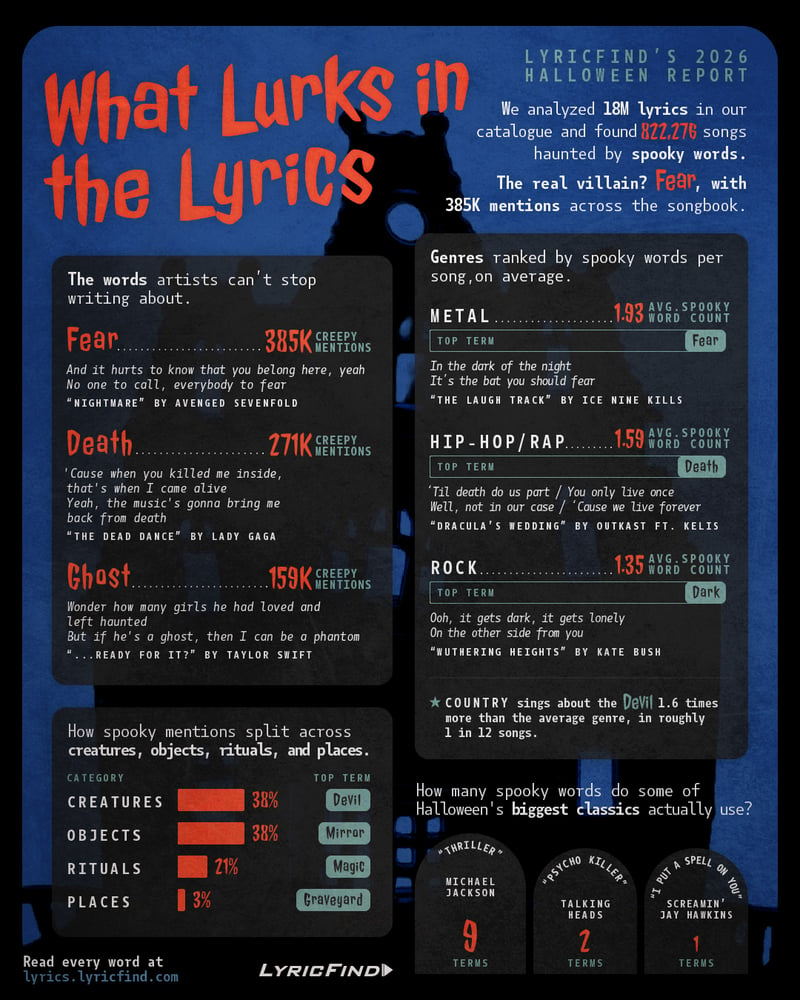
Here's how three songwriting devices (repetition, unfinished stories, and ambiguous pronouns) do the work that a jumpscare usually gets credit for. But first, we dug into the lyrics of more than 800,000 songs to see which genres lean hardest on horror vocabulary, and the biggest surprise isn’t the most haunted genre.
## **By the Numbers: Which Genre Is the Scariest?**
Before the technique comes the vocabulary. Some genres reach for horror words far more often than others. For our Halloween infographic, we scanned the lyrics of more than 800,000 songs for words like "fear," "death," and "ghost." “Fear" topped the list, emerging as the most common Halloween term, with 385,000 mentions.
We looked at the genre-tagged songs across eight genres from Metal and Country to Latin and K-pop. Metal was the most haunted, averaging about two spooky words per song, with Hip-Hop/Rap close behind. The real surprise was Country, which mentions the “Devil” nearly twice as often as the average genre.
## Repetition: The Incantation Effect
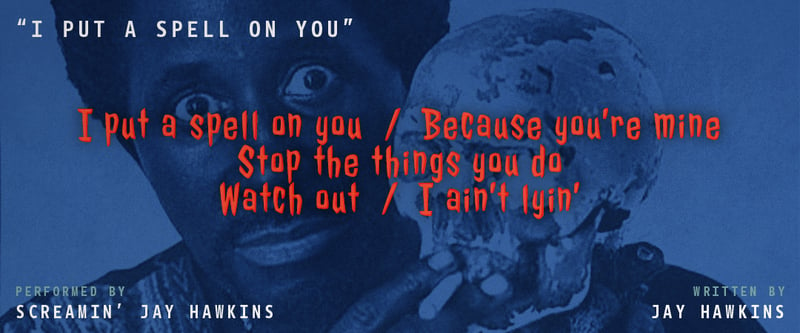
Repeat a phrase enough times and it stops sounding like language. Psychologists call that “semantic satiation.” When used in song, it does something more unsettling: the line starts to feel less like a statement and more like something the speaker can't stop saying. [Screamin' Jay Hawkins](https://open.spotify.com/artist/3VBpsrUi2vV7Uj87ONHu7Z?si=yKxs0uA5RbOZ1YP_FXr3iw) built his whole persona on "[I Put a Spell on You](https://lyrics.lyricfind.com/lyrics/screamin-jay-hawkins-i-put-a-spell-on-you)" in 1956. Written as a love ballad, it became something else once Hawkins recorded it as an obsessive loop, circling the same possessive line until it sounded like someone who can’t let go. Several radio stations refused to play it, and shock rock borrowed from it for decades.
[](https://lyrics.lyricfind.com/lyrics/screamin-jay-hawkins-i-put-a-spell-on-you)
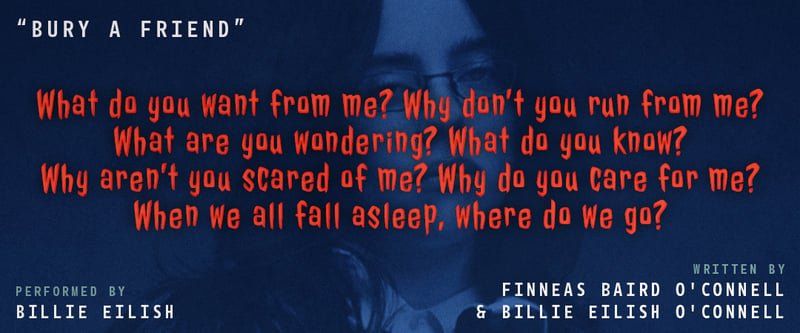
More than sixty years later, [Billie Eilish](https://open.spotify.com/artist/6qqNVTkY8uBg9cP3Jd7DAH?si=2hBlHIvOS3GKrnRyPYKo-Q) ran the same trick at a whisper. "[bury a friend](https://lyrics.lyricfind.com/lyrics/billie-eilish-bury-a-friend)"(2019), builds its dread from a loop of quiet, repeated questions, proof the device doesn't need volume.
[](https://lyrics.lyricfind.com/lyrics/billie-eilish-bury-a-friend)
The Unfinished Story: The Fear of What's Withheld
Leave a story unfinished or a threat unnamed and the listener fills in the blank, usually with something worse than the songwriter could have spelled out. Imagination rarely shows mercy.
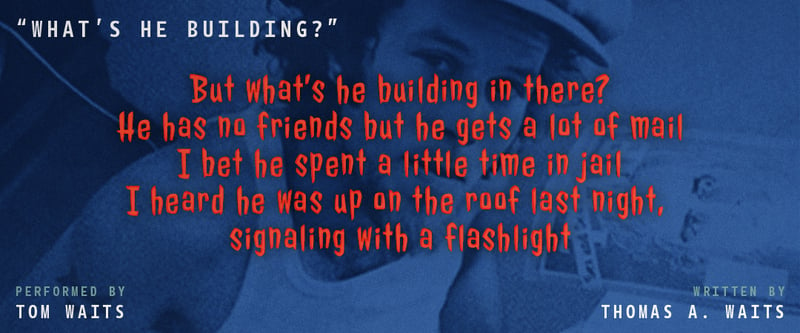
[Tom Waits](https://open.spotify.com/artist/7x83XhcMbOTl1UdYsPTuZM?si=1D8aiMoJSfSCzZ_KYSVT1Q) built "[What's He Building?](https://lyrics.lyricfind.com/lyrics/tom-waits-whats-he-building)" from 1999's [*Mule Variations*](https://lyrics.lyricfind.com/albums/tom-waits-mule-variations), an entirely spoken-word track around a neighbour's paranoid speculation about the strange sounds and comings and goings next door. The title is a question the song never answers, and that’s the point: no reveal could be scarier than not knowing.
[](https://lyrics.lyricfind.com/lyrics/tom-waits-whats-he-building)
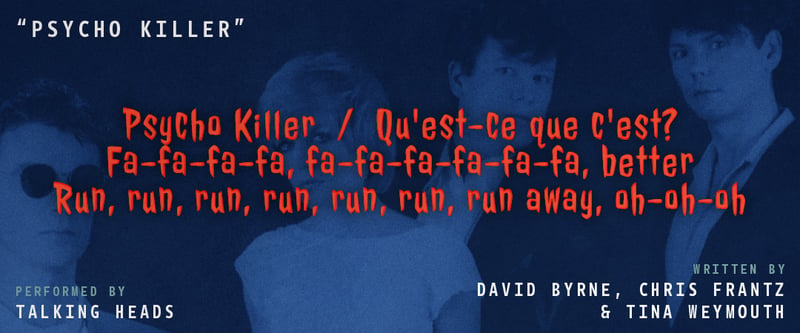
[Talking Heads](https://open.spotify.com/artist/2x9SpqnPi8rlE9pjHBwmSC?si=egLoMXFMTjSQCoFTVotdag) got there another way with "[Psycho Killer](https://lyrics.lyricfind.com/lyrics/talking-heads-psycho-killer)" in 1977. The song sits inside the head of a narrator whose thoughts don't quite connect, with no backstory and no explanation. Then the bridge switches to French, putting on more layer between the listener and whatever is being confessed.
[](https://lyrics.lyricfind.com/lyrics/talking-heads-psycho-killer)
## **Ambiguous Pronouns: Who's Speaking, and to Whom**
A well-placed "you," "it," or "somebody" can rattle a listener more than any named subject could.
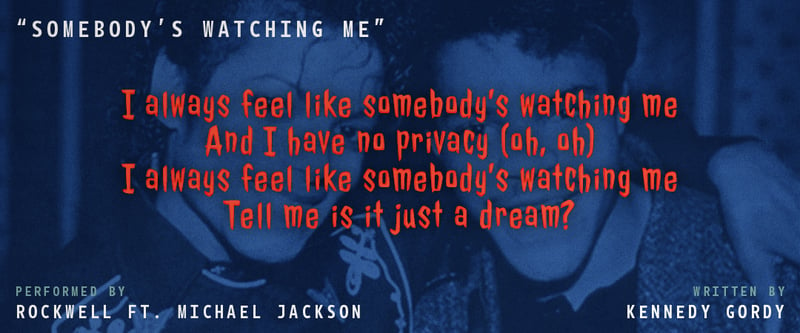
[Rockwell](https://open.spotify.com/artist/3xs0LEzcPXtgNfMNcHzLIP?si=vF1WZ694QO2UbJ9JfZf2gw)'s 1984 hit "[Somebody's Watching Me](https://lyrics.lyricfind.com/lyrics/rockwell-somebodys-watching-me)," with [Michael Jackson](https://open.spotify.com/artist/3fMbdgg4jU18AjLCKBhRSm?si=jKlZqgn2TxqBgrvUzjpRdQ) on the chorus, never says who the “somebody” is. That one unresolved word drives the song's paranoia. Give the watcher a face or a motive and the tension is gone.
[](https://lyrics.lyricfind.com/lyrics/rockwell-somebodys-watching-me)
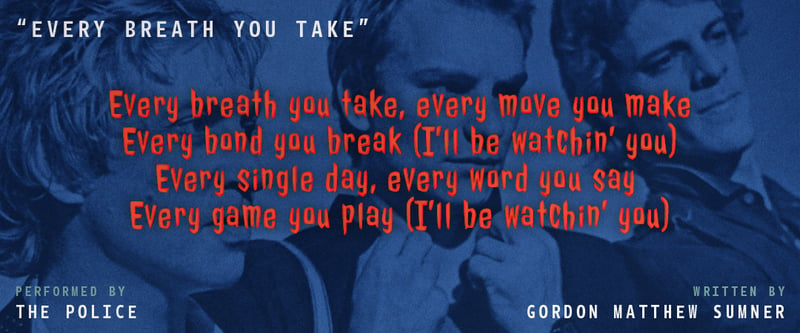
[The Police](https://open.spotify.com/artist/5NGO30tJxFlKixkPSgXcFE?si=xxDTfImkRBG0PQeZpTEMzQ)’s "[Every Breath You Take](https://lyrics.lyricfind.com/lyrics/the-police-every-breath-you-take)" (1983) flips it: Here the watcher is the one singing. Its steady loop of surveillance lines has played at weddings for decades as a love song, but [Sting](https://open.spotify.com/artist/0Ty63ceoRnnJKVEYP0VQpk?si=EhodkuRgQ_akmB5qCdWdqw) has said he meant something darker, possessiveness and control dressed up in the language of devotion. The lyric never tells you whether “I” is a devoted lover or a controlling one, and that’s why it still unsettles anyone who listens closely.
[](https://lyrics.lyricfind.com/lyrics/the-police-every-breath-you-take)
## **Why Exact Words Matter**
None of these devices survive a paraphrase. They depend on exact repetition, and exact restraint. Translations raise the stakes: a repeated phrase can lose its rhythm, and an ambiguous “it” or “you” may have to pick a gender or a level of formality in another language. Good lyric translation exists to carry that intent across as faithfully as possible. So the next time an unsettling song comes on this October, pull up the lyrics and follow along. The dread was built one word at a time, and it's usually more deliberate than it sounds.
Catch us in November,
The LyricFind Team
*Written by: Kayla Higgins, Copywriter & Content Coordinator*
Share: [linkedin-in icon](http://www.linkedin.com/shareArticle?mini=true&url=https://blog.lyricfind.com/lyricfind-out-loud/the-anatomy-of-a-scary-lyric) [facebook-f icon](http://www.facebook.com/share.php?u=https://blog.lyricfind.com/lyricfind-out-loud/the-anatomy-of-a-scary-lyric) [twitter icon](https://twitter.com/intent/tweet?url=https://blog.lyricfind.com/lyricfind-out-loud/the-anatomy-of-a-scary-lyric) [envelope icon](mailto:?body=https://blog.lyricfind.com/lyricfind-out-loud/the-anatomy-of-a-scary-lyric)
www.lyricfind.com
[Follow us on Facebook](https://www.instagram.com/lyricfindofficial) [linkedin-in icon](https://www.linkedin.com/company/1317338) [facebook-f icon](https://www.facebook.com/LyricFind/) [twitter icon](https://x.com/LyricFind?ref_src=twsrc%5Egoogle%7Ctwcamp%5Eserp%7Ctwgr%5Eauthor)
Copyright © 2026, LyricFind
```json
{
"@context" : "https://schema.org",
"@type" : "BlogPosting",
"author" : {
"@type" : "Person",
"name" : "LyricFind",
"url" : "https://blog.lyricfind.com/lyricfind-out-loud/author/lyricfind"
},
"dateModified" : "2026-10-26T13:34:07.474Z",
"datePublished" : "2026-10-26T13:33:10.000Z",
"headline" : "The Anatomy of a Scary Lyric",
"image" : [ "https://blog.lyricfind.com/hubfs/LFOutLoud-HeaderAsset_Oct.gif" ],
"mainEntityOfPage" : {
"@id" : "https://blog.lyricfind.com/lyricfind-out-loud/the-anatomy-of-a-scary-lyric",
"@type" : "WebPage"
},
"publisher" : {
"@type" : "Organization",
"logo" : {
"@type" : "ImageObject",
"url" : "https://blog.lyricfind.com/hubfs/LF-Wordmark-1.png"
},
"name" : "LyricFind"
}
}
```
```json
{
"@context" : "http://schema.org",
"@type" : "Article",
"author" : {
"@type" : "Person",
"name" : [ "LyricFind" ]
},
"datePublished" : "2026-10-26T13:33:10+0000",
"description" : "How repetition, unfinished stories, and ambiguous pronouns build dread in music's scariest songs, plus which genres use the most horror vocabulary.",
"headline" : "The Anatomy of a Scary Lyric",
"image" : "https://23524843.fs1.hubspotusercontent-na1.net/hubfs/23524843/LFOutLoud-HeaderAsset_Oct.gif",
"publisher" : {
"@type" : "Organization",
"logo" : {
"@type" : "ImageObject",
"url" : "https://23524843.fs1.hubspotusercontent-na1.net/hubfs/23524843/LF-Wordmark-1.png"
},
"name" : "LyricFind"
},
"url" : "https://blog.lyricfind.com/lyricfind-out-loud/the-anatomy-of-a-scary-lyric"
}
```